
The PlantData.Live team supports growers and specialists with the management of sensor data. We have built knowledge about the quality of sensors by helping to implement them in your business and research.
Voor fruitteler bespreekt dit artikel welke inzichten u kunt verwachten van precisie-dendrometers.
Thanks to Adaptive Irrigation, we achieve the same yield with about 30% less water consumption.
Contact us to discuss what these results could mean for you.
Data-driven decision making
Every investment in sensor technology must lead to insights to support the management of orchards. Wij halen onze informatie bij de gebruikers van de TreeTagThis wireless precision dendrometer, spread across the fruit grower's plots, results in data-driven decisions in three areas:
- Precise irrigation – Reduces water loss and ensures optimal hydration of the trees.
- Stress detection before visible symptoms – Helps prevent drought, diseases, and environmental damage.
- Insight into growth cycles – Supports pruning, thinning, and fertilization strategies.
Insights for stone fruit growers
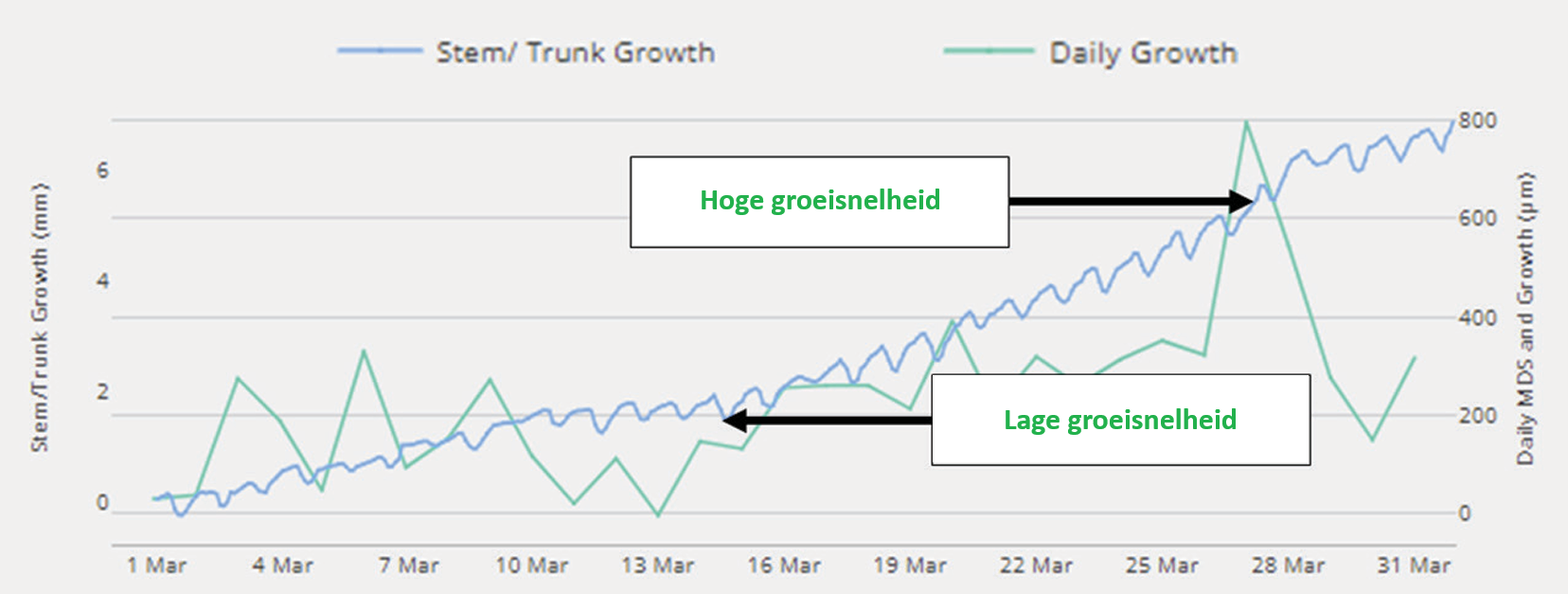
Stone fruits such as plums, cherries, nectarines, and apricots have a unique double-sigmoid growth pattern. Stem fluctuations correlate with critical physiological changes throughout the season.
Tracking important growth phases
- Phase I (Early fruit development): Rapid vegetative growth means that the stem elongation is at its peak.
- Phase II (Hardening of the pit): The trunk growth slows down and the trees become very sensitive to water stress.
- Phase III (Final Swelling): Patterns in stem expansion help growers detect pre-harvest water stress, which can affect fruit size and quality.
Prevention of water-related stress
- By detecting the shrinkage of the stem due to insufficient water, growers can optimize irrigation to prevent yield loss.
- Avoiding excessive irrigation during the pit's lignification phase reduces the risk of fruit splitting and improves overall quality.
Comparing data with plants at another location
A plum grower with 100,000 trees can compare trunk growth and stress patterns with other trees in his orchard.
Book a consultation today with our specialist
Insights for apple and pear growers
Apple and pear growers may be skeptical about the usefulness of the TreeTag, but monitoring trunk fluctuations also offers them significant benefits:
Water stress and irrigation optimization
- Stem shrinkage signals water stress, allowing irrigation to be timed accurately to maintain the health of the tree.
- This prevents both overwatering (which can cause diseases) and underwatering (which reduces crop yield and quality).
Early stress detection
- Stem shrinkage can indicate heat stress, drought, or root problems before visible symptoms appear.
- Early intervention helps maintain consistent fruit production and reduce losses.
Monitoring of seasonal growth
- Trees go through specific growth phases—understanding trunk expansion trends aids in pruning, thinning, and fertilization decisions.
- Growth analysis reveals the vitality of trees and helps growers manage the productivity of the orchard over multiple seasons.
Effect of frost or heat on trees
- The TreeTag, in particular, records how trees respond to extreme temperature fluctuations. This sensor system has a built-in thermometer and moisture sensor. Artificial intelligence assists the grower in interpreting the condition of a plant or tree.
- Rapid shrinkage can indicate cold damage or heat stress, allowing growers to take protective measures in a timely manner.
Field experiences
Dendrometers are effectively used by various fruit growers to monitor the water status of trees, manage irrigation, and improve fruit quality. A wireless system makes it easy to distribute measurement points. Here are some examples:
- Apple Orchards: In the state of Washington, apple farmers have integrated dendrometers into their irrigation management. These devices measure fluctuations in trunk circumference, providing insight into the water status of the tree. Based on this data, growers can optimize irrigation schedules to maintain tree health and improve fruit quality.
- General fruit cultivation: According to Applied Horticultural Research measures dendrometers accurately for plant growth, fruit ripeness, and stress levelsThis information enables fruit growers to monitor growth patterns and health, adjust irrigation, and determine optimal harvest times, leading to better yield quality.
- Almond orchards: In California, almond growers use stem dendrometers to assess water stress in trees by monitoring microvariations in stem diameter. This data helps make irrigation decisions to maintain tree health and optimize nut quality.
Sensor specifications
We have not yet found a wireless precision dendrometer that is easier to implement than it. TreeTag sensor system.
Let us know what your experiences are with dendrometers in fruit cultivation. We are eager to learn from your experience as well.