What is a dendrometer?
A dendrometer measures the diameter of a trunk with micrometer precision, continuously and day after day.
Everyone knows that a tree gradually grows thicker. What is less well known: that diameter never stands still. On top of the slow accretion there is a daily pulse. Over the course of a day and night the trunk swells and shrinks a little, in a rhythm that reflects the plant's water balance. It is precisely those tiny movements that a dendrometer captures — too small for the naked eye, but full of information about how the plant is doing.
For reference. Besides trunk thickness, which is what we will discuss here, the term dendrometer is also used to measure the thickness or volume of a fruit.
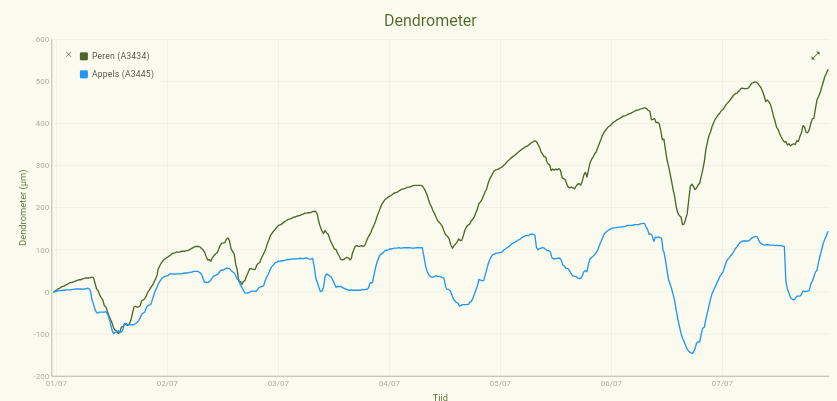
In the graph above you see two trees — a pear tree and an apple tree — over one week. The overall line rises; that is the growth. But every day the signal curls up and down: that is the daily pulse. And it is precisely from that pulse that a single continuous measurement series lets you derive several meaningful values. For example, the signal often reveals water stress days before you notice anything with the naked eye.
The diameter never stands still
During the day the plant transpires through its stomata. It draws water from the trunk tissues faster than the roots can supply it, causing the trunk to shrink slightly. At night — or when transpiration is low — transpiration drops, the tissue refills with water and the plant can grow: the trunk swells and reaches a new maximum the following morning.
The maximum therefore usually occurs around sunrise, when the tree experiences the least strain from transpiration. The minimum falls in the afternoon.
The calculated values
From that single measurement series of trunk thickness we derive a number of values. Important to know in advance: to truly read cause and effect in the data you need more than just the dendrometer value. Temperature, humidity and soil moisture, for example, also determine your tree's water balance, above all to interpret the shrinkage and the water deficit correctly.
Daily growth
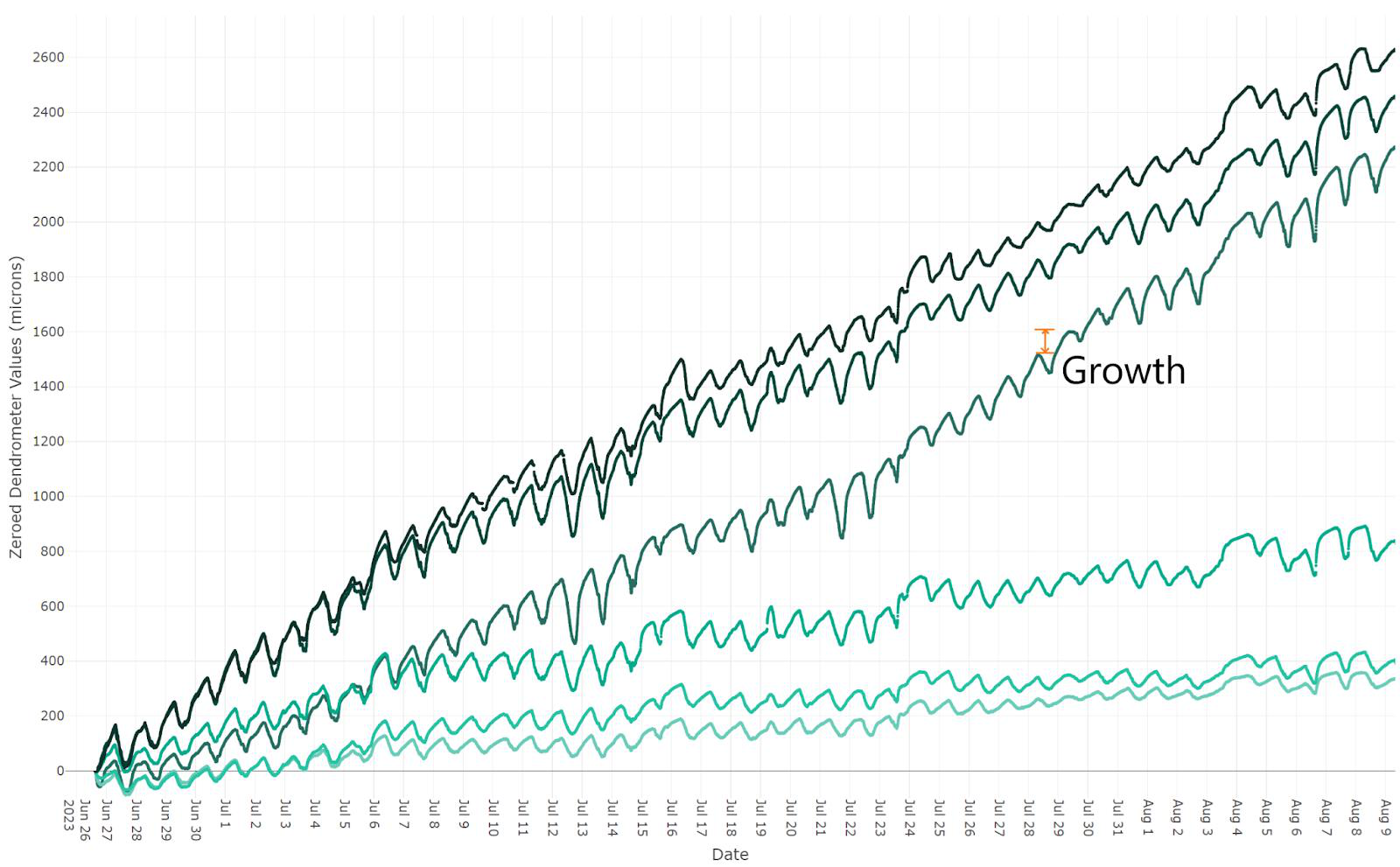
The growth is the net increase in trunk diameter, measured as the difference between the morning maxima of two consecutive days. This is a measure of irreversible accretion: newly formed wood (xylem) stays permanently. A healthy, well-watered plant grows a little more each day.
Growth is most useful as a relative measure. It differs from tree to tree and even between measuring points on the same tree, and it says the most when you compare it over time or between groups of trees — for example a group that receives less water versus an otherwise identical group. Negative growth does not mean wood is lost; the tree simply stops getting thicker for a while, due to water stress for instance. A brief setback is normal (think of winter dormancy in deciduous trees), but prolonged negative growth is a cause for concern.
Daily shrinkage (MDS)
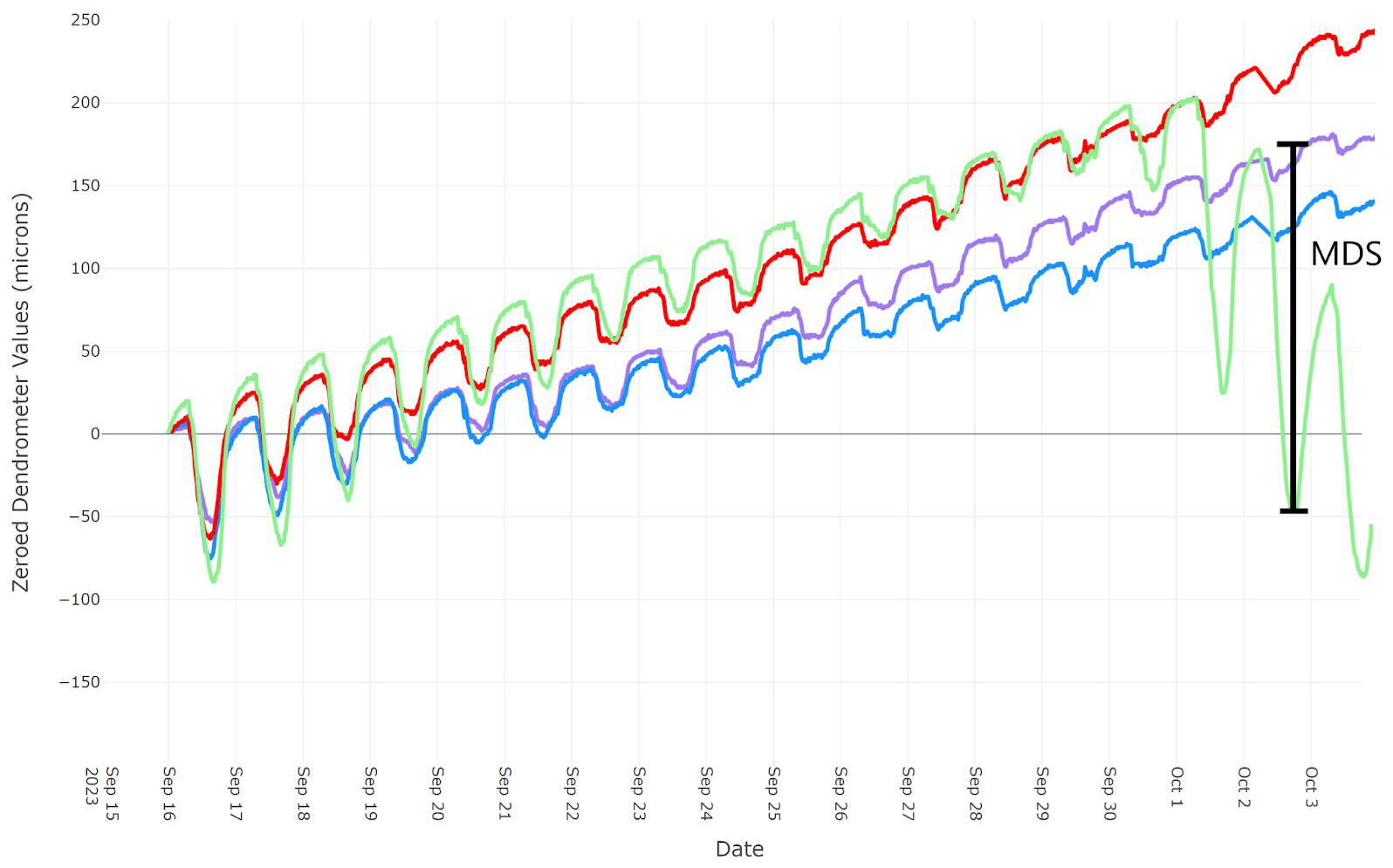
The daily shrinkage, or Maximum Daily Shrinkage (MDS), looks at the same curve but in reverse: the difference between the previous night's maximum and the current day's minimum. Where growth shows the long-term accretion, the MDS shows the reversible daily contraction caused by transpiration. It is one value per day.
The larger the MDS, the greater the relative tension in the tree's sap that day. The value varies from day to day with the conditions: higher temperature, lower humidity and more solar radiation push the MDS up, and a lower soil moisture content raises it too. Like growth, the MDS is best read relatively — against other trees or against the same tree earlier in time. If the MDS suddenly changes differently relative to temperature or humidity than before, that can point to a changed soil moisture level.
Water deficit (TWD)
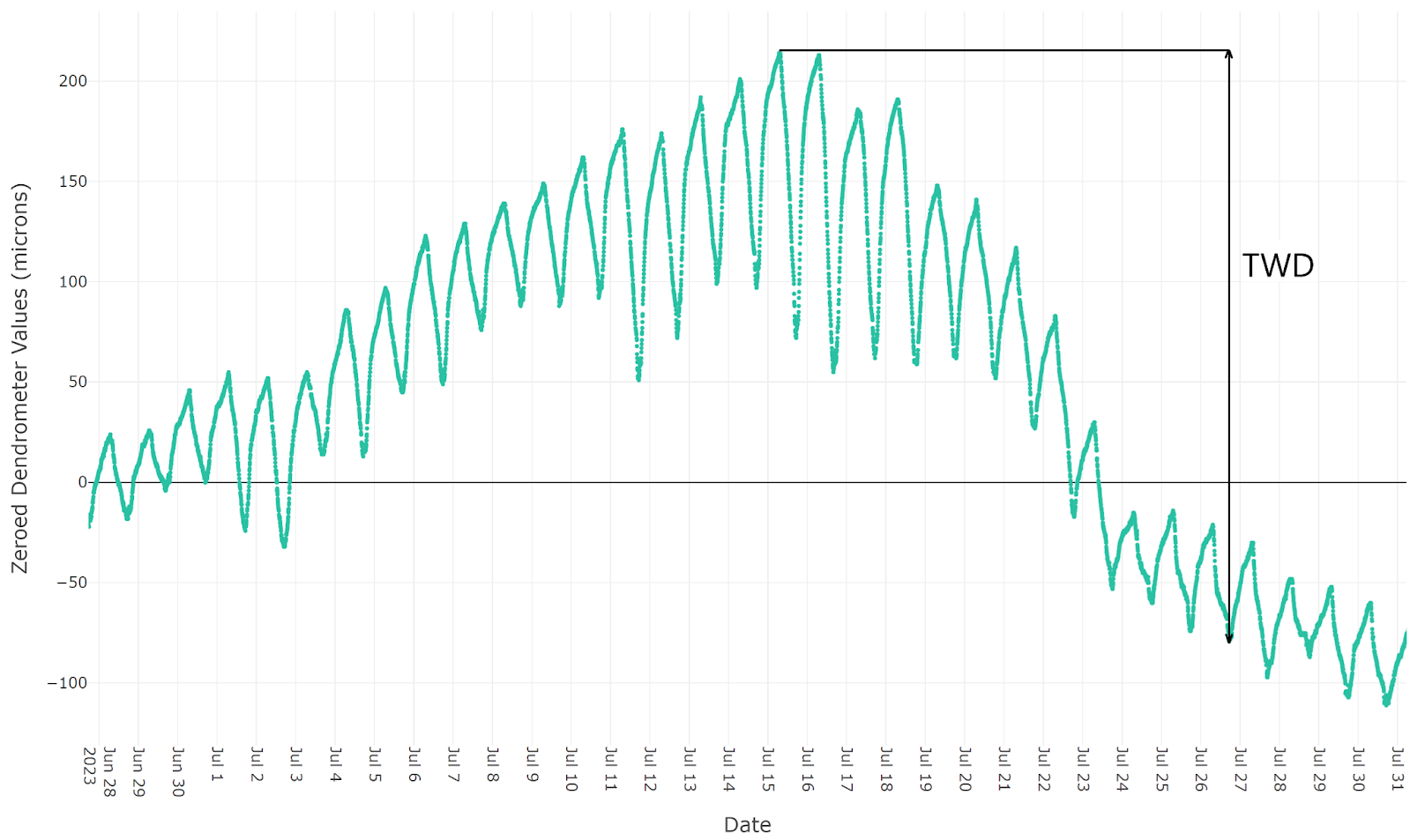
The water deficit, internationally Tree Water Deficit (TWD), is the difference between the current diameter and the highest maximum the tree recently reached. At any moment it is roughly the distance between the current diameter and that "fully pumped-up" reference. Unlike the daily shrinkage, this is a cumulative measure: in a healthy tree the deficit falls back to zero at night, but if that recovery fails to occur, the residual value is what builds up over several days as a structural water deficit.
The TWD is usually reported as one value per day. Yet you can also compute it at interim points within the day — giving you an early warning even before the day is over.
That is where the added value lies. Under sustained stress the daily shrinkage can stay stable or even decrease, while the water deficit keeps rising. Many days of negative growth together with a rising water deficit is therefore the clearest signal of structural water stress. You typically see this pattern when a tree suddenly stops receiving irrigation — for example due to a faulty valve or a clogged dripper.
Source & further reading: the water deficit itself is computed entirely from the dendrometer series (zero-growth concept, Zweifel et al., 2016); for a normalized version that is comparable across trees and species, see Peters et al., 2025.
In practice: recognising water stress in time
In summary, each value tells its own part of the story:
- Growth stalls or flattens → the plant is under stress, or the conditions (light, temperature, nutrition) are unfavourable.
- Shrinkage increases day after day → the transpiration demand is rising, or the water supply is falling short.
- Water deficit does not recover at night → adjust in time with irrigation or climate, before growth drops off.
In short: growth tells you whether the plant is making progress, and the daily shrinkage and the water deficit show the water tension in the tree — together they reveal whether water stress is building up. How the air itself pulls at that tension — the vapour pressure deficit (VPD) — is covered in our separate article on transpiration.
Have you worked with dendrometer data before?
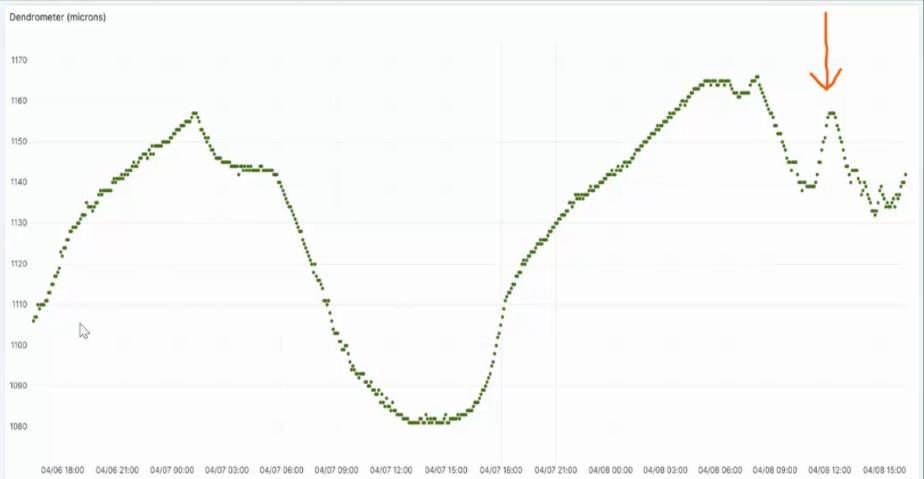
The responsiveness is remarkable. To illustrate: during the solar eclipse of 8 April 2024, active dendrometers recorded how trees reacted in their diameter — a variation of just a quarter of the thickness of a human hair. You can imagine that the smallest deviation in vigour caused by diseases or pests becomes measurable with this instrument.
From measurement data to insight
A sensor delivers figures; the real value lies in what you do with them. The PlantData.Live software brings the measurement data together and translates it into actionable insights for monitoring the condition of trees — for arborists, fruit growers, tree nurseries and researchers.
Those insights are moreover live — hence the name. The measurements stream in continuously and in real time, so you are not looking at a snapshot from yesterday, but at the current state of your trees, day and night.
That way you do not have to watch the graphs yourself day and night: the PlantData.Live software notifies you as soon as these key values deviate, so you can intervene before there is visible damage. Sharing, exporting or automatically feeding measurements into other processes is possible too.
Frequently asked questions
What exactly does a dendrometer measure? A dendrometer measures the diameter of a trunk (or fruit) at the micrometer level, continuously. From that measurement you derive the daily growth, the daily shrinkage and the water deficit of the tree.
How do you see water stress on a dendrometer? Water stress shows itself as an increasing daily shrinkage and, above all, as a water deficit that no longer fully recovers at night and rises day after day. You often notice this days before the tree visibly suffers.
What is the difference between daily shrinkage and water deficit? The daily shrinkage is the reversible contraction within a single day. The water deficit (Tree Water Deficit) is cumulative: it measures how far the tree lags behind its recent maximum and builds up under sustained water stress.
What is the difference between vapour pressure deficit (VPD) and water deficit (TWD)? The vapour pressure deficit (VPD) is an air measure in kPa, calculated from temperature and humidity: it tells you how hard the air pulls water out of the tree. The water deficit (TWD) is a trunk measure in µm, measured with the dendrometer: it tells you how much water the tree itself is short of. The VPD is the cause, the TWD the effect.
From what trunk diameter does dendrometry work? There is a sensor available for every trunk or twig diameter.
More from our knowledge base
Why dendrometry reveals water stress: the structure of a tree
Bark, cambium and sapwood: why the trunk shrinks and why growth stops first.
What is vapour pressure deficit (VPD)?
How hard the air pulls water out of the tree — the driver behind water stress.
Dendrometer with continuous measurement
Your trees’ water stress live in the app, with a same-day notification when drying out becomes severe.
Regulated deficit irrigation: smarter watering with less water
How mild, well-timed water stress saves water, and why you measure it with a dendrometer.