Dendrometry in fruit cultivation?
Only irrigate when necessary - and still maintain your production levels
Let your fruit trees tell you when they need water and make decisions based on data, not on gut feeling. This way, you secure this year's harvest and your profits for the coming years.
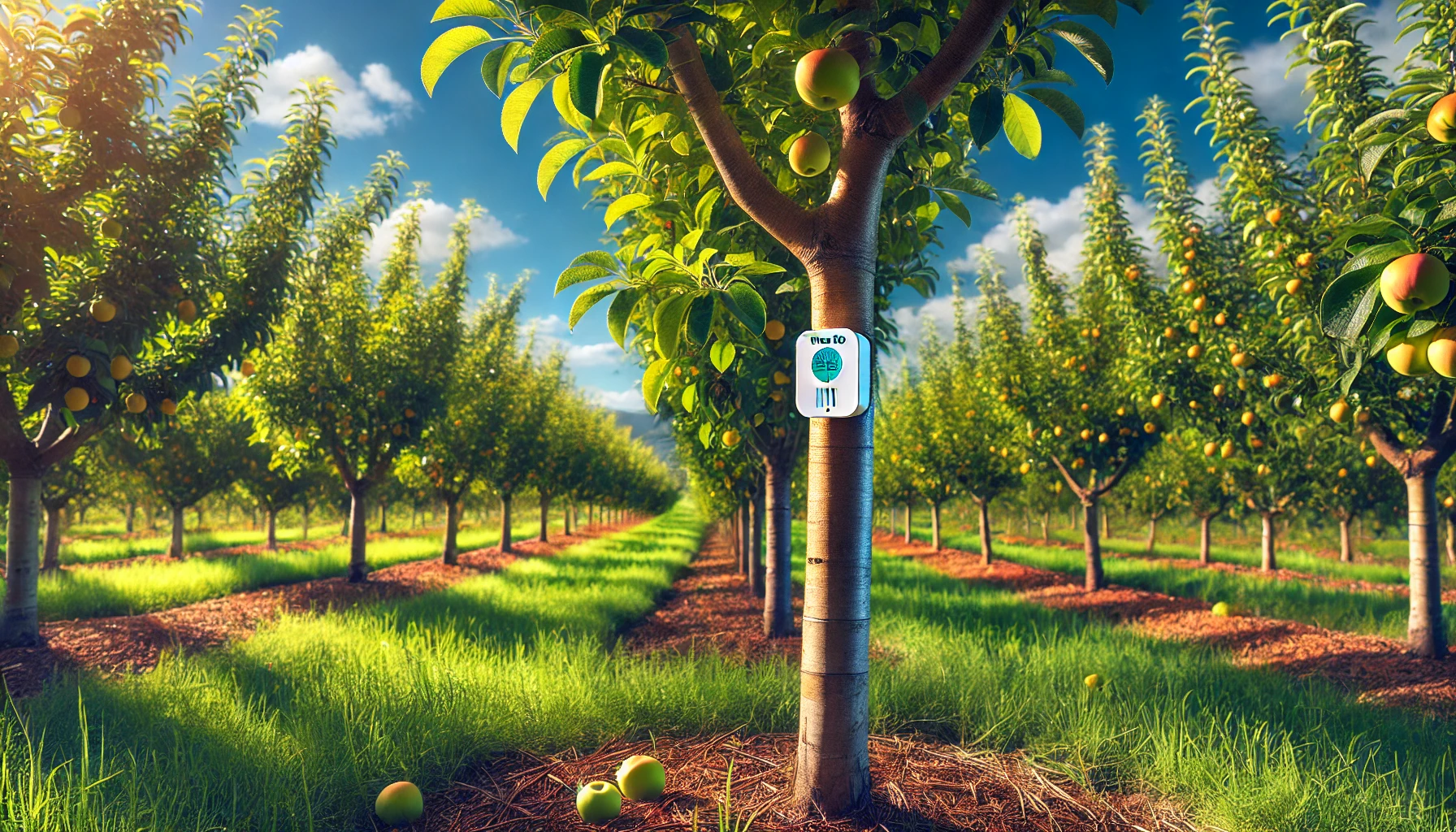
Not an experiment, but proven practice
PlantData.Live gives you an accurate picture of the water stress of your reference trees.
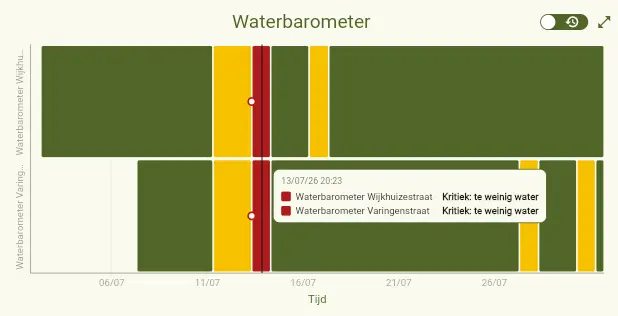
Our algorithm is based on the scientifically grounded practices of fruit growers worldwide.
- Washington (USA): apple growers integrate dendrometers into their irrigation management for healthier trees and better quality.
- California (USA): almond growers measure micro-variations in the trunk to assess water stress accurately.
- Research (Applied Horticultural Research): dendrometers measure growth, ripeness and stress levels accurately — and help determine the optimal harvest time.
"Thanks to adaptive irrigation, we achieve the same yield with about 30% less water."
The reality on a fruit farm
Water is becoming more expensive and scarcer. The regulations around it are getting stricter. Sometimes there is a pumping ban even before the end of the growing season. At the same time, dry summers and heatwaves are becoming the new normal. Therefore, you must achieve a better harvest with less water — year after year.
The tricky part: a tree only shows water stress once it is already too late. By the time you see wilting or fruit drop, the tree has already lost yield and quality. As a result, irrigation stays largely guesswork:
- Too little water → smaller fruit, lower grade, yield loss.
- Too much water → fruit cracking, higher disease pressure and wasted water and money.
- Wrong timing → missed growth in exactly the phase that counts.
And every wrong decision costs you twice: in water and in harvest, this year and in the years to come.
Smarter irrigation starts with the right measurements
What if you could "hear" your trees before the first visible stress? Then irrigation turns from guesswork into an informed decision.
Growers who monitor their trees continuously already achieve:
- The same yield with about 30% less water.
- Larger and more uniform fruit, by adjusting at exactly the right moment.
- Less loss, by catching cracking, drought stress and disease early.
- A future-proof business, ready for stricter water rules and drier summers.
The difference is not more work, but better information.
Measuring the area around your tree
- Precipitation
- Sun
- Humidity
- Soil moisture
- Irrigation
Listening to your tree itself?
How it works with our customers
A precision dendrometer measures micro-changes in the trunk diameter — movements you would never spot with the naked eye. From these you read two things:
Water stress, before the symptoms
If the trunk shrinks, the tree is thirsty — often days before the leaves show it. No lab, no estimates. Just what the tree is doing at this moment — wirelessly monitored across all your plots.
Growth, phase by phase
The growth curve shows which growth phase the tree is in, so you align pruning, thinning, fertilisation and irrigation with it.
Restricting growth is desirable during certain periods and promotes better root development.
What it brings you
For stone fruit (plum, cherry, nectarine, apricot)
Stone fruit follows a double-sigmoid growth curve with one particularly sensitive moment: the pit hardening.
- Too much water at that stage increases the risk of cracked fruit
- Too little water costs caliber
With continuous trunk monitoring you see that phase coming and adjust water exactly on time — for larger, sounder fruit.
For apple and pear
Not sure whether trunk monitoring is for pome fruit? The gains lie in timing and in early signals:
- Irrigate exactly when needed — not too much (disease pressure), not too little (caliber loss) so that you can complete the growing season with the available water reserves
- Catch heat, drought or root stress before it becomes visible.
- Track the vitality of your trees across multiple seasons and steer your orchard.
What do you need?
PlantData.Live provides sensors to optimize your water management. Sensors for soil, tree, air, and water volumes.
You can access the data from these sensors through our online platform:
- Read more about this online platform and how it makes your business more efficient
- Or take a look right away via this online demo.
Ready to grow on data instead of gut feeling?
Request your quote or demo without obligation. Together we look at what a precision dendrometer can mean for your plots.
Request your quote or demo or call +32 (0)53 36 30 21