Start-up procedure for controlled green roof irrigation
In this expert article we describe the procedure for calibrating a soil-moisture-controlled irrigation algorithm. We do this using a practical example on a sloped green roof with mature vegetation.
Context: Irrigation of a green roof
A green roof is alive, so it needs water — but not simply at fixed times. Automatic irrigation combines a measurement of the soil moisture in the substrate with a daily schedule, so the roof only receives water when it genuinely needs it. This page explains how that principle works, and — if you already operate a green-roof irrigation controller — helps you set it up and maintain it well.

The principle: measure first, then irrigate
The system combines two things: an adjustable daily schedule, and a moisture measurement in the substrate. This yields the soil moisture as a percentage. At the moments you choose, the system checks how moist the roof is. If it is already sufficiently moist, no water is given. If it is too dry, watering starts. This way the roof only receives water when it truly needs it, and after rain or a previous cycle it simply stays dry.
A scheduled time is therefore not a promise that water will be given — it is a permission moment. At that moment the system checks the soil moisture and decides for itself whether irrigation is needed. That means you can plan generously: a superfluous moment is simply skipped.
Soil moisture as a percentage
The moisture of the substrate is measured and displayed as a percentage: a high percentage means a nicely moist roof, a low percentage a dry one. In the Soil moisture graph you see that percentage over time, with a green zone that indicates the healthy range. If the reading drifts to the dry (too low) or the wet (too high) side, you can tell at a glance that adjustment is needed.

There is no single percentage that is "right" for every roof. The build-up of the substrate, the position of the irrigation points and the placement of the soil-moisture probe make each system unique. So it is best to look at the settings for each installation separately — and in the first weeks after installation you fine-tune as you go.
Setting up the installation
Step 1: When water may flow
You decide on which days and at what time the system may give water. Preferably choose a time in the early morning. Then the least water evaporates, the foliage dries during the day (which prevents fungus) and the soil benefits from the cycle all day long. In warm, dry periods you set more days or several moments per day; in cool or wet periods fewer moments suffice. Thanks to the moisture measurement, superfluous moments are automatically skipped.
On the Irrigate screen you set three things per day: the start moment (which day and at what time), the duration of the cycle (Active for) and the moisture threshold (Only active when … %). Each day can thus have its own setting.

Step 2: Determining the moisture limit values
Determining the upper moisture limit
The moisture threshold (Only active when … %) determines up to which moisture level watering still takes place. The system only gives water as long as the measured soil moisture is below this percentage; as soon as the reading reaches it, the cycle is skipped.
In technical jargon this upper limit is called the Field Capacity (FC).
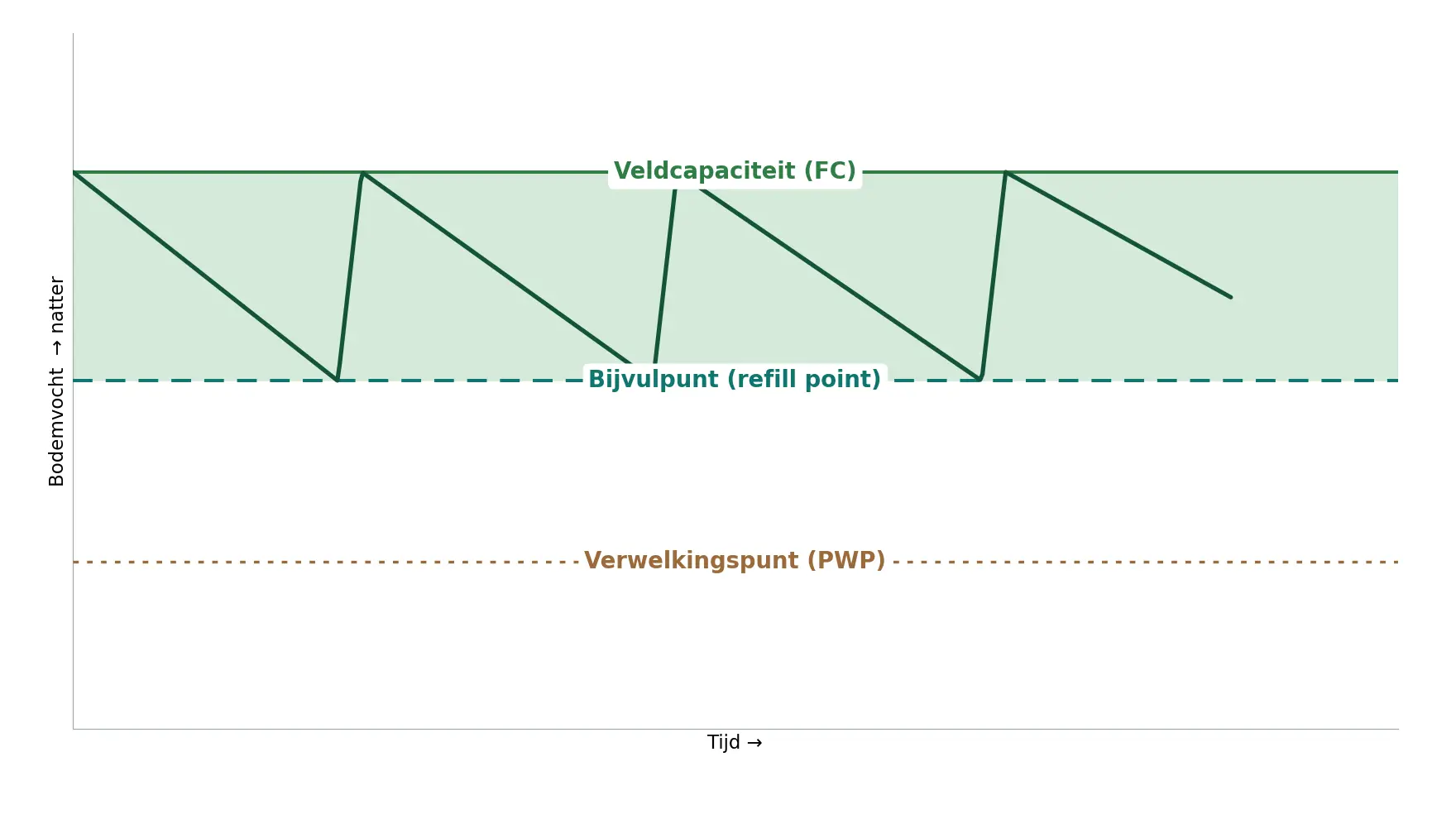
You find a good upper value like this:
- Give the roof a thorough cycle and watch the moisture reading until it flattens out.
- Wait a few hours so the excess water can drain away. Then read the percentage: that is roughly the level at which the substrate is usefully full — more water will not stay anyway.
- Set your moisture threshold just below that read-off percentage.
Note on a sloped green roof: there the excess water often drains away immediately, so after step 1 you already read the practical maximum. That is precisely why it is valuable to follow the rules of thumb below during the first weeks.
Rules of thumb for further refinement: if the threshold is set too high, the system considers the roof too dry almost all the time and waters almost every time (waste and run-off). If it is set too low, the system hardly ever waters and the plants can dry out.
- Do the plants look dry despite the watering? Raise the threshold a little.
- Does the substrate feel wet for long periods instead? Lower it slightly. Feel free to refine this in small steps over a few weeks.
Determining the duration of a cycle
To determine the ideal duration of a cycle, activate the irrigation at a moment when it has not rained for a while. See how long the installation takes to reach the desired moisture level. That duration is the length you best set under Active for.
Thorough watering works better than a daily splash. On a green roof with full planting the substrate is deeper than on a thin sedum mat. Deeper substrate holds more water and therefore buffers longer. That is why a thorough cycle every few days is often better than a little every day: it stimulates deeper rooting and makes full use of the substrate's buffer.
In short
- Measure first, irrigate then: every scheduled moment is a permission, not an obligation — the moisture measurement decides.
- Soil moisture is a percentage: high = moist, low = dry; a green zone shows the healthy range.
- Set the moisture threshold just below the saturation level and refine in small steps over a few weeks.
- Water preferably in the early morning, and let the system water thoroughly and with intervals for deeper rooting.
- Let the installation monitor itself: you are notified as soon as something deviates.
Curious about the PlantData.Live solution for automatic green roof irrigation?
A good irrigation system controls itself. Through the combination of daily permission moments and your moisture threshold, it only tops up after a few days in cool weather, and daily during heat. All this ensures minimal water consumption — without you having to watch the tap. Ideally the local rainfall forecast is also taken into account, so the roof is not watered unnecessarily just before a rain shower.
Frequently asked questions
How does automatic irrigation of a green roof work? The system combines a daily schedule with a continuous measurement of the soil moisture in the substrate. At each scheduled moment it checks the moisture and decides for itself whether irrigation is needed: is the roof dry, then the pump starts; is it moist enough, then the cycle is skipped.
In what unit is the soil moisture displayed? As a percentage. A high percentage means a nicely moist roof, a low percentage a dry one. The dashboard shows a green zone that indicates the healthy range.
What is the moisture threshold and how do I set it? The moisture threshold ("Only active when … %") is the percentage up to which watering takes place. The system only gives water as long as the reading is below that threshold. You determine it by giving the roof a thorough cycle, waiting a few hours until the excess water has drained, reading off the percentage and setting your threshold just below that value. Then refine in small steps.
What time of day is best for watering? In the early morning. Then the least water evaporates, the foliage dries during the day (which prevents fungus) and the soil benefits from the cycle all day long.
Is giving a little water every day better than a thorough cycle now and then? On a green roof with deeper substrate, no. A thorough cycle every few days uses the water buffer of the substrate and stimulates deeper rooting. The system arranges that automatically based on the moisture measurement.
What if there is a malfunction, such as a blockage or water shortage? The system detects the anomaly itself and sends a signal via WhatsApp, Microsoft Teams or e-mail. Using the data you quickly make a diagnosis, without having to go on site periodically.
More from our knowledge base
Automatic irrigation for green roofs
Our self-monitoring irrigation solution for flat, sloped and vertical green roofs.
What is a dendrometer?
How you measure tree growth and water stress — the knowledge behind PlantData.Live.